 Commustat

This time, I would like to use our own indicator, the Rush Commute Index®, to look at the four additional round trips during the weekday morning rush that the Fukuoka City Subway Nanakuma Line will add in its November 24 timetable revision.
Checking the projection against the number of trains
The Fukuoka City Transportation Bureau has announced that its November 24 timetable revision will add four round trips during the 7 a.m. to 9 a.m. hours on weekday mornings. Toward Hakata, trains in the 7 a.m. hour will increase from 12 to 13, in the 8 a.m. hour from 18 to 20, and in the 9 a.m. hour from 12 to 13. As a result, the congestion rate on the most crowded section, Yakuin to Watanabe-dori, is expected to fall from the current 130% to 115%. The bureau has also indicated a plan to lengthen the current four-car trains to six cars from FY2030.
Let's check this projected easing of congestion against the number of trains. In the busiest hour, 8 a.m., the number of trains rises from 18 to 20, an increase of about 11%. If ridership stays the same, the congestion rate becomes 130% × 18 ÷ 20, or roughly 117%, which is nearly in line with the city's projection.
How does it change as an index?
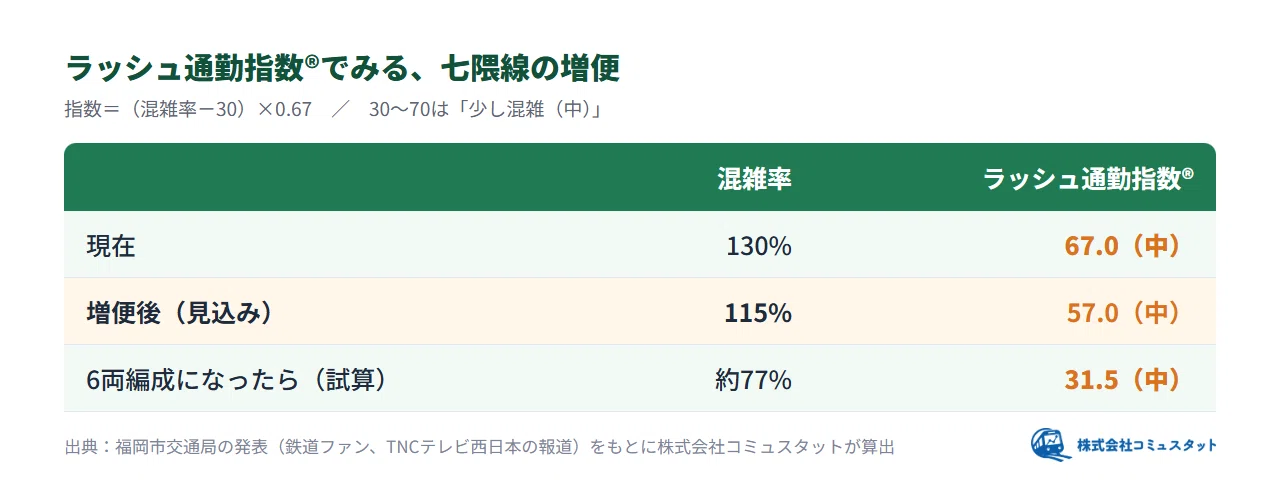
Let me also look at this service increase using the Rush Commute Index. (The Rush Commute Index® is our own index that quantifies commuting burden based on the congestion rates published by MLIT. A congestion rate of 30% is set at 0 points and about 180% at 100 points.)
On the index, this is a 10-point improvement, from 67.0 to 57.0. Looking at crowding at the exact peak time (1.1 times the published figure in our calculation), the category drops one level, from 75.7 ("High") to 64.7 ("Medium"). Read through the Rush Commute Index, I believe this is a level at which people who ride the most crowded train every morning will clearly feel the difference.
If six-car trains raise transport capacity by 1.5 times, a simple calculation puts the congestion rate at about 77% and the index down to 31.5. At that figure, "Low" comes within sight.
A solution that reaches riders directly
With congestion rising again nationwide, the Nanakuma Line has eased crowding with a solution that reaches riders directly: adding trains and cars. Efforts that ask riders to adapt, such as staggered commuting and working from home, are also important, but if transport capacity itself can be increased, the daily morning burden will certainly become lighter.
We will continue to analyze initiatives like this in numbers and keep making the daily commute to work and school visible.
[Sources]
• Railf (Tetsudo Fan), "Fukuoka City Transportation Bureau to Revise Nanakuma Line Timetable on November 24" (October 14, 2026) https://railf.jp/news/2026/10/14/000000.html
• TNC TV Nishinippon (Yahoo! News), "Four Extra Round Trips in the Morning Rush: Subway Nanakuma Line Timetable Revision on November 24" https://news.yahoo.co.jp/articles/db9226ee4543f4f7176fb35b48f79635e9a55568
#CommuterTrains #FukuokaCitySubway #NanakumaLine #CongestionRelief #RushCommuteIndex #CommuterTrainAnalyst
A free tool that makes commuting burden visible with indices. No sign-up needed.
Check your daily commute