 Commustat

On November 11, the Bureau of Transportation, Tokyo Metropolitan Government opened bids for new cars for the Nippori-Toneri Liner (four trainsets, 20 cars), and Mitsubishi Heavy Industries won the contract at 7.898 billion yen. The plan is to replace the four Type 300 trainsets that have run since the line opened with new cars in which all seats are sideways-facing long seats, increasing the number of passengers they can carry.
The Nippori-Toneri Liner recorded a congestion rate of 176% in FY2025 (Akado-Shogakko-mae → Nishi-Nippori), making it the most crowded line in Japan for the sixth year in a row. Because stations and other facilities were built for five-car trains, it is difficult to lengthen trains while keeping the line running. On October 20, the Adachi Ward Assembly also unanimously adopted a written opinion urging the Tokyo Metropolitan Government to take active steps to ease congestion.
In the previous article, I used the index to look at the service increase that Tokyo aims to introduce in spring 2028. This time, I would like to use our Rush Commute Index to estimate how much the morning burden will change when these new cars replace the old ones.
17 more passengers per trainset, about a 1.3% capacity increase across the line
The original Type 300 cars have some facing cross seats, and each trainset has a capacity of 245 passengers. The Type 330, which makes up most of the current fleet, has increased its capacity to 262 by using long seats throughout. Assuming the new cars also hold 262, each replaced trainset will carry 17 more passengers, about 7% more.
On the other hand, the Nippori-Toneri Liner has 20 trainsets in total, and only four of them are being replaced this time. Averaged across the whole line, the capacity per trainset rises from 258.45 to 261.85, an increase of about 1.3%.
What does it look like as an index?
Assuming ridership stays the same, the congestion rate falls from 176% to 173.7%, and the Rush Commute Index drops 1.5 points, from 97.8 to 96.3. This is a small change for the line as a whole, but for people who have been riding the original cars every morning, it means something a little different.
If every trainset carries the same number of people, the lower-capacity Type 300 cars work out to about 186% (index 104.3), noticeably more crowded than the other cars. Once they are replaced with new cars, this becomes about 174% (index 96.3), a drop of 12 points in congestion rate and about 8 points on the index. In the sense that the most crowded cars disappear and every car becomes about equally crowded, this is a real improvement.
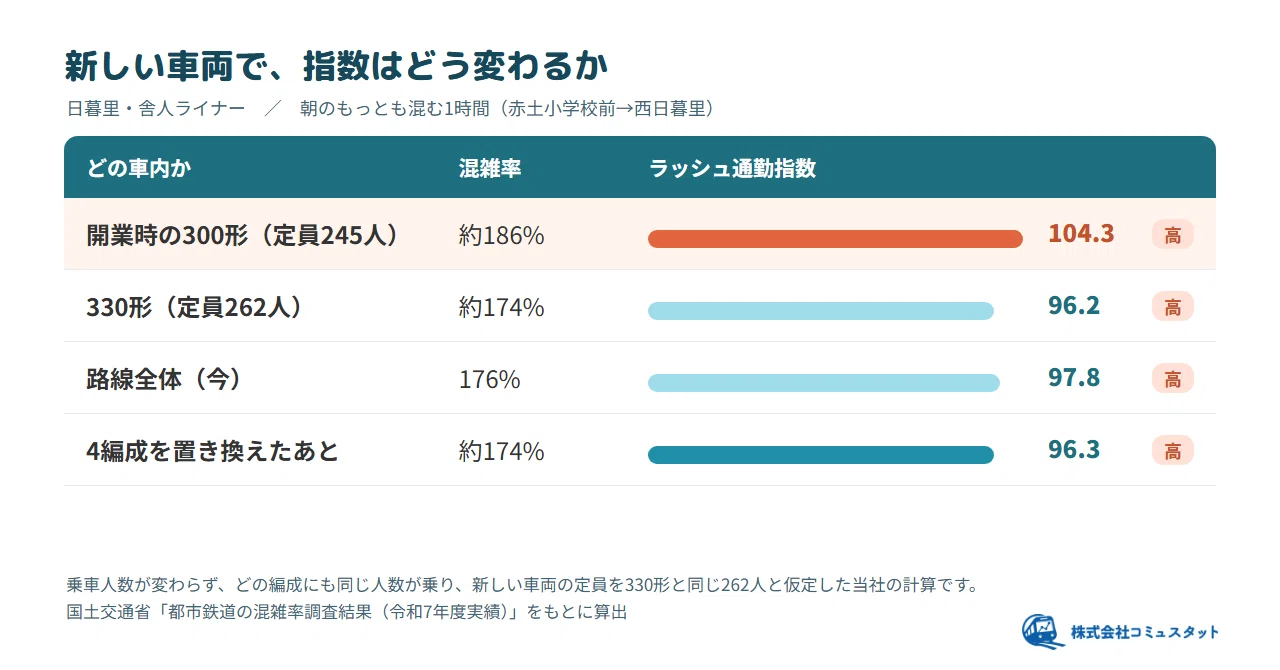
(*) The Rush Commute Index is our own index that quantifies commuting burden based on the congestion rates published by MLIT.
Small steps add up to change every morning
This replacement alone will not lift the Nippori-Toneri Liner out of the "High" category on the Rush Commute Index. However, with lengthening trains so difficult, efforts to increase the number of passengers that can be carried are, I believe, one excellent improvement measure that directly benefits riders. If the service increase targeted for spring 2028 and upgrades to signaling equipment build on this car renewal, a path out of six straight years as "Japan's most crowded line" may gradually come into view.
We will continue to analyze initiatives like this in numbers and explore ways to improve the rush-hour commute by making the daily commute to work and school visible.
(*) These estimates are our own calculations, assuming that ridership does not change, that all 20 trainsets are used equally during the busiest morning hours, and that the new cars have the same capacity as the Type 330 (262 passengers). The capacity of the new cars has not yet been announced.
[Sources]
• Norimono News, "'Trump Card' Deployed to Ease Congestion on 'Japan's Most Crowded Railway Line'! The Original Cars Finally Make Way for a New Generation" (November 12, 2026) https://news.yahoo.co.jp/articles/e2c2724c649fc9eeb058de04de30c825a94202a1
• MLIT, "Survey Results on Congestion Rates of Urban Railways Released (FY2025 Results)" (July 28, 2026) https://www.mlit.go.jp/report/press/tetsudo04_hh_000139.html
• Mynavi News, "Bureau of Transportation, Tokyo Metropolitan Government to Renew Nippori-Toneri Liner Cars, 80% to Get Long Seats" (June 23, 2022) https://news.mynavi.jp/article/20220623-2376550/
#CommuterTrains #NipporiToneriLiner #CongestionRate #CongestionRelief #RushCommuteIndex #CommuterTrainAnalyst
A free tool that makes commuting burden visible with indices. No sign-up needed.
Check your daily commute