 Commustat

In the FY2025 congestion rates published in July by the Ministry of Land, Infrastructure, Transport and Tourism (MLIT), the Nippori-Toneri Liner recorded 176% (down 1 point from the previous year), making it the most crowded line in Japan for the sixth year in a row. During the busiest morning hour, about 8,700 people ride trains with a capacity of about 4,900.
The Tokyo Metropolitan Government has said it aims to increase service in spring 2028 by shortening headways and other means, and to increase passenger capacity by replacing cars with new ones in which all seats are sideways-facing long seats by FY2031. However, it has also been reported that morning headways have already reached the minimum of 3.5 minutes, and that shortening them further would require reviewing the signaling system (ATC) itself.
This time, I would like to use our Rush Commute Index to look at the service increase plan announced by the Tokyo Metropolitan Government.
What does it look like as an index?
The current 176% corresponds to 97.8 on the index, close to the maximum. Looking at crowding at the exact peak time (1.1 times the published figure in our calculation), it is stuck at the maximum of 100.
Running the Nippori-Toneri Liner at 3.5-minute intervals gives about 17 trains per hour. Assuming the number of riders stays the same, I calculated what happens as the number of trains increases.
• One more train per hour (about 18 trains): index of 91.3
• Two more trains (about 19 trains): index of 85.4
• Three more trains (about 20 trains, at 3-minute intervals): index of 80.1
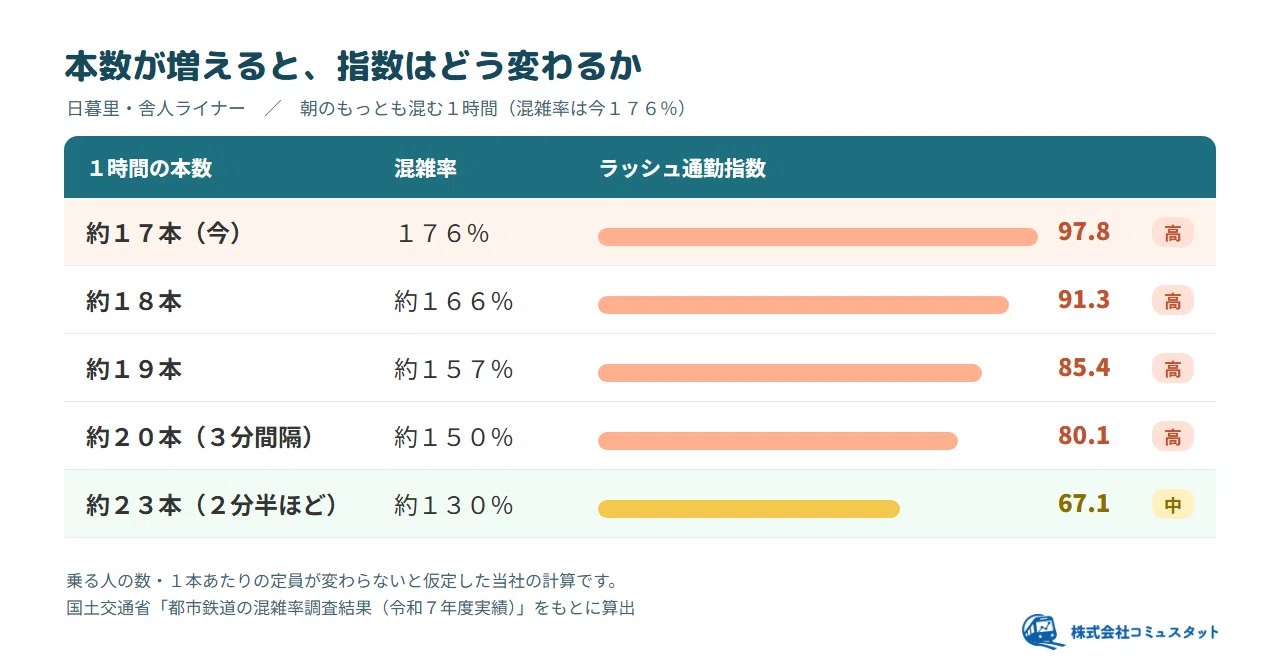
Even one additional train lowers the index by more than 6 points, so it is a real step forward for people who ride every morning. On the other hand, it takes three more trains just to reach the national target of 150%, and even then the index stays in the 80s, within the "High" band. Reaching the "Medium" level would require bringing the congestion rate down to around 134%, and achieving that through train frequency alone would take about 23 trains per hour, at intervals of about 2.5 minutes.
(*) The Rush Commute Index is our own index that quantifies commuting burden based on the congestion rates published by MLIT. Higher values indicate greater crowding.
More trains and new cars, together
What this calculation shows is that crowding on the Nippori-Toneri Liner is at a level that cannot be fully resolved just by adding a few trains. That is exactly why I believe that if both of the measures announced by the Tokyo Metropolitan Government, shorter headways and higher capacity through long seats, can be carried out, and signaling equipment can be upgraded as well, a path out of the "High" band may come into view.
Efforts that ask riders to adapt, such as staggered commuting, are also important, but adding trains and cars is a solution that reaches riders directly. I will keep watching whether the spring 2028 service increase becomes a step toward better mornings along the line.
We will continue to analyze initiatives like this in numbers and explore ways to improve the rush-hour commute by making the daily commute to work and school visible.
(*) The service increase estimates are our own calculations, assuming that the number of riders does not change and that the capacity per train remains the same as now. They do not include the capacity increase from the new cars.
[Sources]
• MLIT, "Survey Results on Congestion Rates of Urban Railways Released (FY2025 Results)" (July 28, 2026) https://www.mlit.go.jp/report/press/tetsudo04_hh_000139.html
• Junichi Sugiyama, "Easing Congestion on the Nippori-Toneri Liner: Can New Technology Boost Capacity?" (Mynavi News, October 25, 2026) https://news.mynavi.jp/article/20261025-nipporitoneriliner/
#CommuterTrains #NipporiToneriLiner #CongestionRate #CongestionRelief #RushCommuteIndex #CommuterTrainAnalyst
A free tool that makes commuting burden visible with indices. No sign-up needed.
Check your daily commute