 Commustat

November is "Comfortable Commuting Promotion Month." In 1993, the then Ministry of Transport and Ministry of Labour established the Comfortable Commuting Promotion Council, which, together with business, labor, academic experts and local governments, has designated November each year as the month for encouraging off-peak commuting through staggered working hours and flextime. Records also show that in 2002, an off-peak commuting campaign was held in the Tokyo metropolitan area for the full month from November 1 to 30.
In recent years, there have been fewer occasions to see this month itself promoted, but local governments and railway companies have continued their own initiatives in its place, such as the Tokyo Metropolitan Government's "Summer Off-Peak Commuting Promotion Period," JR East's off-peak commuter passes and Tokyu's "Yutorhythm Commute."
This time, in keeping with the annual Comfortable Commuting Promotion Month, I would like to use our Rush Commute Index to look at how much your commuting burden changes if you take the morning train one hour earlier.
How does the index change if you go one hour earlier?
In the congestion rate survey published in July 2018, the Ministry of Land, Infrastructure, Transport and Tourism (MLIT) showed for the first time, for major lines in the Tokyo area, the congestion rates for the hours before and after the busiest hour (the peak side) in addition to the busiest hour itself. The data is somewhat old, and conditions have improved considerably since then as telework has spread, but for reference, converting the congestion rates for the busiest hour and the hour before it into the index gives the following.
• Tokaido Line (Kawasaki → Shinagawa): 187%, 100 (maximum) → one hour earlier: 164%, 89.8
• Chuo Line Rapid (Nakano → Shinjuku): 184%, 100 (maximum) → 162%, 88.4
• Saikyo Line (Itabashi → Ikebukuro): 185%, 100 (maximum) → 154%, 83.1
• Tokyo Metro Marunouchi Line (Shin-Otsuka → Myogadani): 165%, 90.5 → 139%, 73.0
• Tokyo Metro Hibiya Line (Minowa → Iriya): 157%, 85.1 → 132%, 68.3
• Tobu Isesaki Line (Kosuge → Kita-Senju): 149%, 79.7 → 124%, 63.0
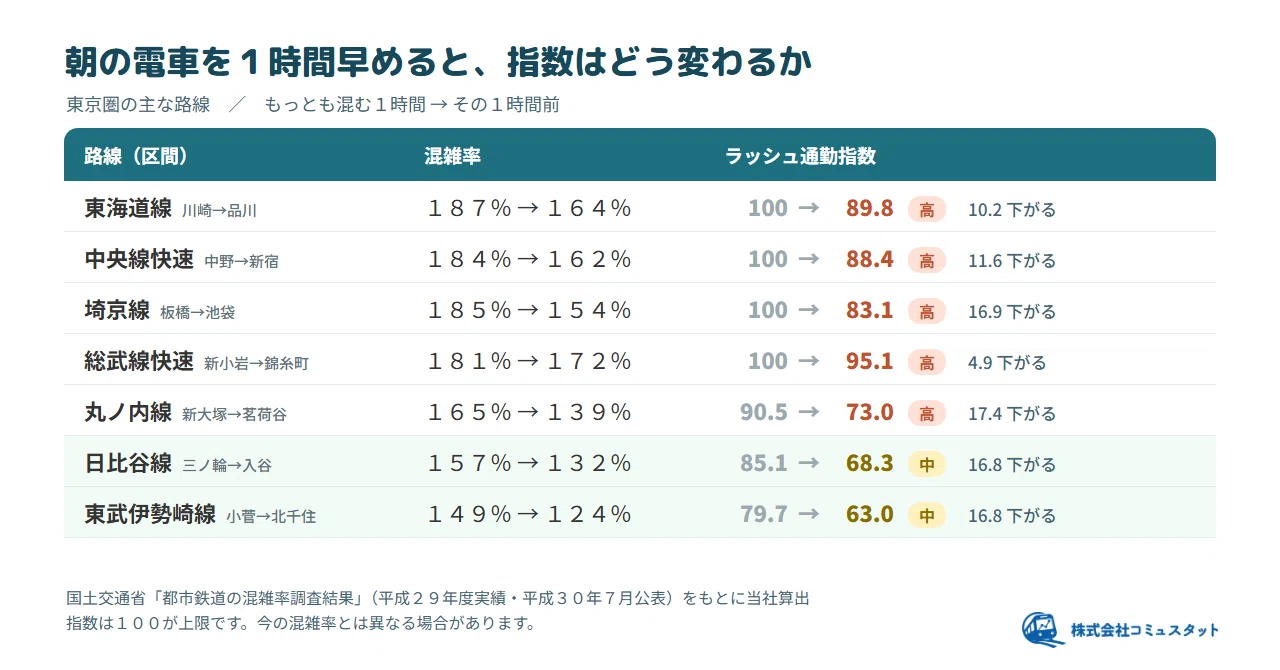
On many lines, going just one hour earlier lowers the index by about 10 to 20 points, and on some, such as the Hibiya Line and the Tobu Isesaki Line, it drops from the "High" band to the "Medium" band. On the other hand, the Sobu Line Rapid (Shin-Koiwa → Kinshicho) is still at 172% (index 95.1) one hour earlier, not much different from the busiest hour, which shows that many people are already riding early in the morning.
(*) The Rush Commute Index is our own index that quantifies commuting burden based on the congestion rates published by MLIT. Higher values indicate greater crowding.
Shifting travel times and adding trains
What this calculation shows is that the effect of shifting travel times varies greatly from line to line. On lines where the index drops to the "Medium" band, simply adjusting the time you go in can clearly lighten the daily morning burden. On lines that are crowded from early on, however, shifting times alone cannot do everything, and I believe it is essential to combine it with efforts to add trains and cars.
Moreover, whether people can shift their travel times depends largely not just on individual effort but on their employer's start times and work arrangements. If Comfortable Commuting Promotion Month can become an opportunity not only for employees but also for companies to review start times and ways of working, I believe the daily commute can be made much better.
We will continue to analyze initiatives like this in numbers and explore ways to improve the rush-hour commute by making the daily commute to work and school visible.
(*) The congestion rates for the busiest hour and the hour before it are values published by MLIT as FY2017 results. They may differ from current congestion rates.
Sources
• Ministry of Health, Labour and Welfare, press release (September 4, 2001) https://www.mhlw.go.jp/houdou/0109/h0904-1.html
• MLIT, "Overview of the 2002 Off-Peak Campaign" https://www.mlit.go.jp/sogoseisaku/offpeak/offpeak2002_.html
• "What Changes with Off-Peak? A History of Off-Peak Commuting" (and E magazine, May 11, 2023) https://www.andemagazine.jp/2023/05/11/off-peak-history.html
• MLIT, "Lines with Congestion Rates Above 180% in the Tokyo Area Down from 12 to 11: Survey Results on Congestion Rates of Urban Railways Released" (July 17, 2018) https://www.mlit.go.jp/report/press/tetsudo04_hh_000068.html
#CommuterTrains #ComfortableCommutingMonth #OffPeakCommuting #StaggeredHours #CongestionRate #RushCommuteIndex #CommuterTrainAnalyst
A free tool that makes commuting burden visible with indices. No sign-up needed.
Check your daily commute