 Commustat

On November 13, the Ministry of Internal Affairs and Communications announced the number of relocation inquiries received by local governments nationwide in FY2025. The total came to 447,403, up 13,593 from the previous year and the highest since the survey began in FY2015. Of these, 329,202 were inquiries at consultation desks and 118,201 were at relocation events, with event inquiries in particular rising by more than 20,000 from the previous year. By prefecture, Nagano (26,345) had the most for the second year in a row, followed by Fukushima (21,524) and Hokkaido (19,014).
In FY2016 there were about 210,000 inquiries, so the number has more than doubled in nine years. The number of permanent relocation consultation desks set up by prefectures has also grown by 6 from the previous year to 185, which suggests that receiving communities are steadily building up their support.
There is more than one way to relocate
When people hear "relocation," many may picture life in a distant rural area. On the other hand, keeping your current job while moving to the suburbs of the Tokyo metropolitan area or to a seaside town has also become an increasingly common choice in recent years. If you are considering this kind of move, I believe that, in addition to rent levels and access to nature, how heavy the daily commute will be is another important factor that shapes your quality of life.
What does the index show for commuting from Nagano to central Tokyo?
So this time, let me use our indicators to estimate the case of commuting to Shinjuku Station in central Tokyo from Nagano Prefecture, which had the most relocation inquiries for the second year running. To arrive at Shinjuku Station at 8:40 on a weekday from Nagano Station, one typical route is to take the Hokuriku Shinkansen to Omiya and transfer to the Shonan-Shinjuku Line. The ride time is about 105 to 120 minutes, and you would leave Nagano Station at around 6:20 a.m. Even from Ueda Station, the ride time is about 92 to 119 minutes.
The Ride Load Score, which is calculated from ride time and the number of transfers, reaches its maximum of 100 points. In addition, the morning congestion rate on the Shonan-Shinjuku Line from Omiya is 150%, which corresponds to about 80 on our Rush Commute Index, in the "High" category. Combining the two gives a Commute Burden Index of 86. (*)
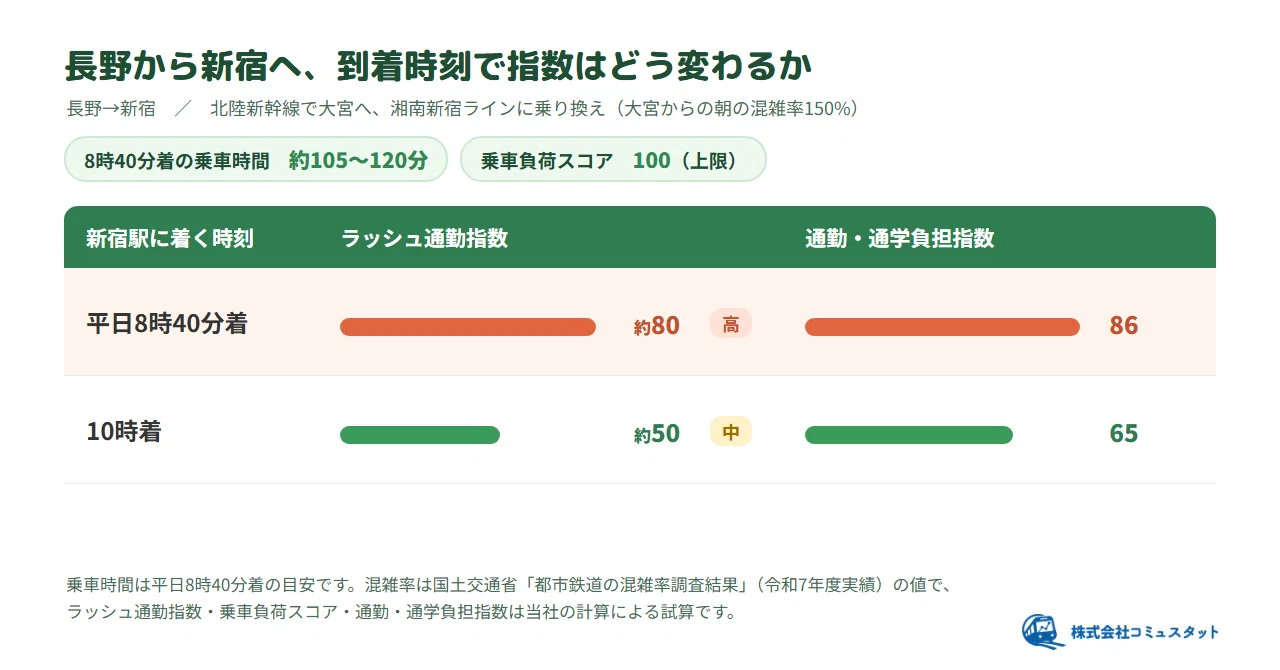
With the Shinkansen, commuting from Nagano to central Tokyo is possible in itself. Still, it is worth knowing in advance, in numbers, what it means to leave home in the 6 a.m. hour every morning, spend nearly two hours each way on trains, and end each trip on a crowded train into central Tokyo, day after day.
(*) The Rush Commute Index is our own index that quantifies commuting burden based on the congestion rates published by MLIT.
Going in a few times a month: a hybrid work arrangement
If you are considering commuting from far away like this, I believe a hybrid arrangement, where you usually work from home and go to the office only a few set times a month, is one way to keep it up without strain. With fewer office days, it may be easier to balance the burden of long trips with the benefits of living close to nature.
Moreover, simply arriving a little later on office days changes the burden figures. In our estimate, arriving at Shinjuku Station at 10:00 lowers the Rush Commute Index to about 50 ("Medium" category) and the Commute Burden Index to 65. These are only rough guides, but they can be one factor to consider when choosing what time to go in.
We see the record number of relocation inquiries as a sign that more and more people want to rethink how they live. When considering how you work and where you live together, checking the burden of the daily commute in numbers should lead to better choices. We will continue to support better choices in how people live by making the daily commute to work and school visible.
(*) Ride times are estimates for arrival at 8:40 on a weekday. Congestion rates are taken from MLIT's "Survey Results on Congestion Rates of Urban Railways" (FY2025 results), and the Rush Commute Index, Ride Load Score and Commute Burden Index are our own estimates.
Sources
• Ministry of Internal Affairs and Communications, "Survey Results on Relocation Inquiries in FY2025 (Number of Inquiries Received at Relocation Consultation Desks, etc.)" (November 13, 2026) https://www.soumu.go.jp/menu_news/s-news/01gyosei08_02000336.html
• LIMO, "[Latest, November 2026] Relocation Inquiries Hit a Record of Over 440,000! The Top 5 Most Popular Prefectures" (November 16, 2026) https://news.yahoo.co.jp/articles/224ebe5d55576445b46547d5d83bc1e73b417ff3
• MLIT, "Survey Results on Congestion Rates of Urban Railways Released (FY2025 Results)" (July 28, 2026) https://www.mlit.go.jp/report/press/tetsudo04_hh_000139.html
Install Office Locator here
Office Locator (App) | Commustat Co., Ltd.
A free tool that makes commuting burden visible with indices. No sign-up needed.
Check commuting after relocating