 Commustat

On November 17, Amazon Japan opened its new office on the 34th to 44th floors of Mori JP Tower at Azabudai Hills in Tokyo to the press. The office has a total floor area of about 46,000 m². Amazon Web Services Japan (AWS Japan) began moving in in May, and several Amazon Japan teams have since moved in as well, completing the move. With dual monitors at every seat and about 80% of the desks height-adjustable, the office puts a strong emphasis on the work environment, and the working style is, in principle, five days a week in the office.
In September 2024, CEO Andy Jassy announced a policy requiring employees to come to the office five days a week, which has applied since January 2025. As hybrid work combining remote and office days has spread, this has drawn attention as a company deliberately choosing daily office attendance.
Three days versus five days a week: 1.7 times the commuting burden
More office days means more days on crowded trains. For example, going from three to five office days a week means 1.7 times as many morning commutes. For someone with a one-way ride time of about 40 minutes, the weekly time spent on trains, counting both ways, increases from about 4 hours to about 6 hours and 40 minutes.
What does the index show for commuting from Kita-Senju to Kamiyacho?
Azabudai Hills is directly connected to Kamiyacho Station on the Tokyo Metro Hibiya Line. So let me use our indicators to estimate the case of commuting from Kita-Senju, a popular transfer hub along the Hibiya Line. To arrive at Kamiyacho at 8:40 on a weekday, you can take the Hibiya Line with no transfers, and the ride time is about 38 minutes.
The Ride Load Score, calculated from ride time and the number of transfers, is 38 points. In addition, the congestion rate on the Hibiya Line's most crowded morning section (Minowa → Iriya) is 163%, and trains from Kita-Senju toward central Tokyo pass through this section. This corresponds to about 89 on our Rush Commute Index, in the "High" category. (*)
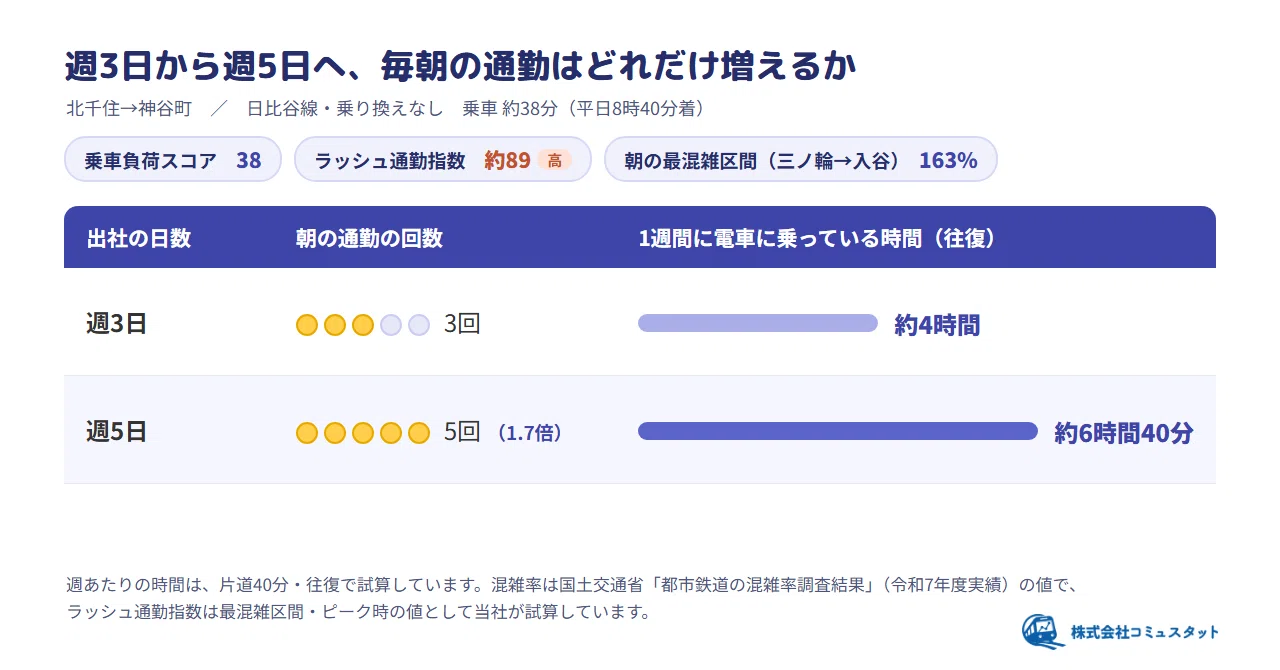
Going to the office is by no means a bad choice, but when the start of the workday coincides with the morning peak, coming in five days a week means traveling through this crowding every single day.
(*) The Rush Commute Index is our own index that quantifies commuting burden based on the congestion rates published by MLIT.
The real question is not "going to the office" but "the rush-hour commute"
Working face to face as a team has its advantages, and I believe this effort to improve the work environment to support that is one excellent improvement measure. On the other hand, there may still be room to rethink requiring employees to come in every day while knowing it means commuting during rush hour, without changing that underlying assumption.
If measures such as allowing flexible start times so that employees can come in outside the peak, or helping employees check the commuting burden when choosing where to live, are combined, coming to the office every day should become easier to sustain.
We will continue to explore ways to improve the rush-hour commute by making the daily commute visible, both in choosing office locations and in helping employees choose where to live.
(*) Ride times are estimates for arrival at 8:40 on a weekday. Congestion rates are taken from MLIT's "Survey Results on Congestion Rates of Urban Railways" (FY2025 results), and the Rush Commute Index is estimated as the value for the most crowded section at peak time. Weekly times are estimated based on a 40-minute one-way trip, counting both ways.
Sources
• Impress Watch, "Amazon Unveils Azabudai Office with Dual Monitors, Height-Adjustable Desks and Even a Japanese Garden" (November 17, 2026) https://news.yahoo.co.jp/articles/2648c71faf0652d507b005e5af0b45b7c79460cc
• Amazon, "Amazon Expands Its Tokyo Office, Opening a New Base at Azabudai Hills" (May 18, 2026) https://press.aboutamazon.com/jp/2026/5/amazon-expands-tokyo-office
• CNN.co.jp "Amazon (US) Asks Employees to Come to the Office Five Days a Week" (September 2024) https://www.cnn.co.jp/tech/35223982.html
• MLIT, "Survey Results on Congestion Rates of Urban Railways Released (FY2025 Results)" (July 28, 2026) https://www.mlit.go.jp/report/press/tetsudo04_hh_000139.html
Install Office Locator here
Office Locator (App) | Commustat Co., Ltd.
A free tool that makes commuting burden visible with indices. No sign-up needed.
Think about your office location